Your phone, smartwatch and health apps can collect remarkably personal information. As digital health grows, understanding where that data goes is becoming part of taking care of yourself.
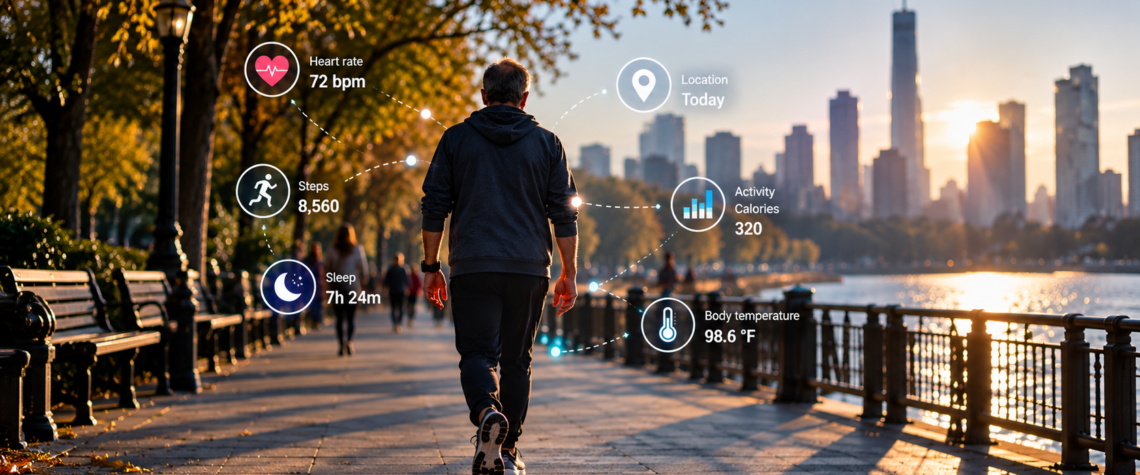
Your phone may know how many steps you took today. Your smartwatch may know when you went to sleep, how long you exercised and what your heart rate was during your morning walk. A health app may know your weight, medications, eating habits or other information about your body. Individually, these pieces of information may seem insignificant. Together, they can create something remarkably intimate: a digital portrait of your health.
We are measuring ourselves more than ever
For most of human history, information about our bodies was collected occasionally. You stepped on a scale. A doctor measured your blood pressure. A nurse took your temperature. Digital devices have changed that. A smartwatch can collect information throughout the day. A phone can record movement and location. Apps can help people track food, exercise, sleep, medications and other aspects of daily life. For many people, that information is genuinely useful. It can reveal patterns that are difficult to notice otherwise. But collecting information raises another question: What happens to it after it is collected?
Health data doesn’t always stay in the doctor’s office
When we think about medical privacy, we often imagine a doctor’s office or hospital. But much of today’s personal health information is generated somewhere else entirely. It may come from a watch, a fitness tracker, a smartphone or an app downloaded in a few seconds. Different services may have different privacy practices, storage policies and ways of sharing information. That means consumers need to distinguish between information contained in traditional medical records and health-related information they voluntarily provide to consumer technology services. They may look similar on a screen. They may not be protected or handled in exactly the same way.
Convenience has a price
Digital health services often become more useful when they know more about us. An exercise app works better when it knows our activity. A sleep tracker needs information about our sleep. A health assistant may provide more relevant information when it knows something about our circumstances. That creates a familiar technology trade-off:
We give information in exchange for convenience.
The important question is whether we understand the exchange.
Before you tap “Allow”
Most of us have become remarkably good at accepting permissions. A box appears. We tap Allow. Another appears. We tap Continue. The entire process may take only a few seconds. But health information deserves a little more hesitation. Before connecting an app to your health data, ask a few simple questions. What information does this app actually need? Does it need access to everything—or only one type of data? Can I change those permissions later? Can I delete the information if I stop using the service? A minute spent examining privacy settings may reveal more than pages of terms and conditions most people will never read.
Your body is producing data
We often talk about personal data as though it were something stored on a computer. Increasingly, however, our bodies themselves are producing the data.
Our movement.
Our sleep.
Our heartbeats.
Our exercise.
Our habits.
Technology can transform those signals into information that may help us understand ourselves better. That is an extraordinary possibility. But the more intimate the technology becomes, the more important another digital skill becomes as well: knowing who is listening.